
From Hearing Conversations to Accessible Conversations
For many Deaf and Hard-of-Hearing individuals, everyday conversations can be difficult to follow. Missing spoken information during healthcare appointments, classrooms, meetings, and daily interactions often creates frustration and limits participation.
While existing solutions focus on transcription, few focus on the complete communication experience. This revealed an opportunity to design a solution that helps users participate more confidently in conversations.

As I explored the problem further, I found that communication challenges extended beyond healthcare into classrooms, workplaces, and everyday interactions. However, most existing solutions focused on transcription alone, leaving significant gaps in contextual support, personalization, and accessibility.

Designing for Confidence, Not Just Captions
Research showed that communication challenges extend beyond speech recognition. Users needed context, trust, and flexibility throughout conversations.
Rather than building another captioning tool, I focused on creating a communication companion that adapts to different environments and communication needs.
Conversation Modes
Adapting the experience to different communication environments.

The SignBridge Experience
A unified experience for real-time communication and accessibility.This led to features such as Conversation Modes, Speaker Identification, Confidence Indicators, and Accessibility Personalization.

A More Inclusive Communication Experience
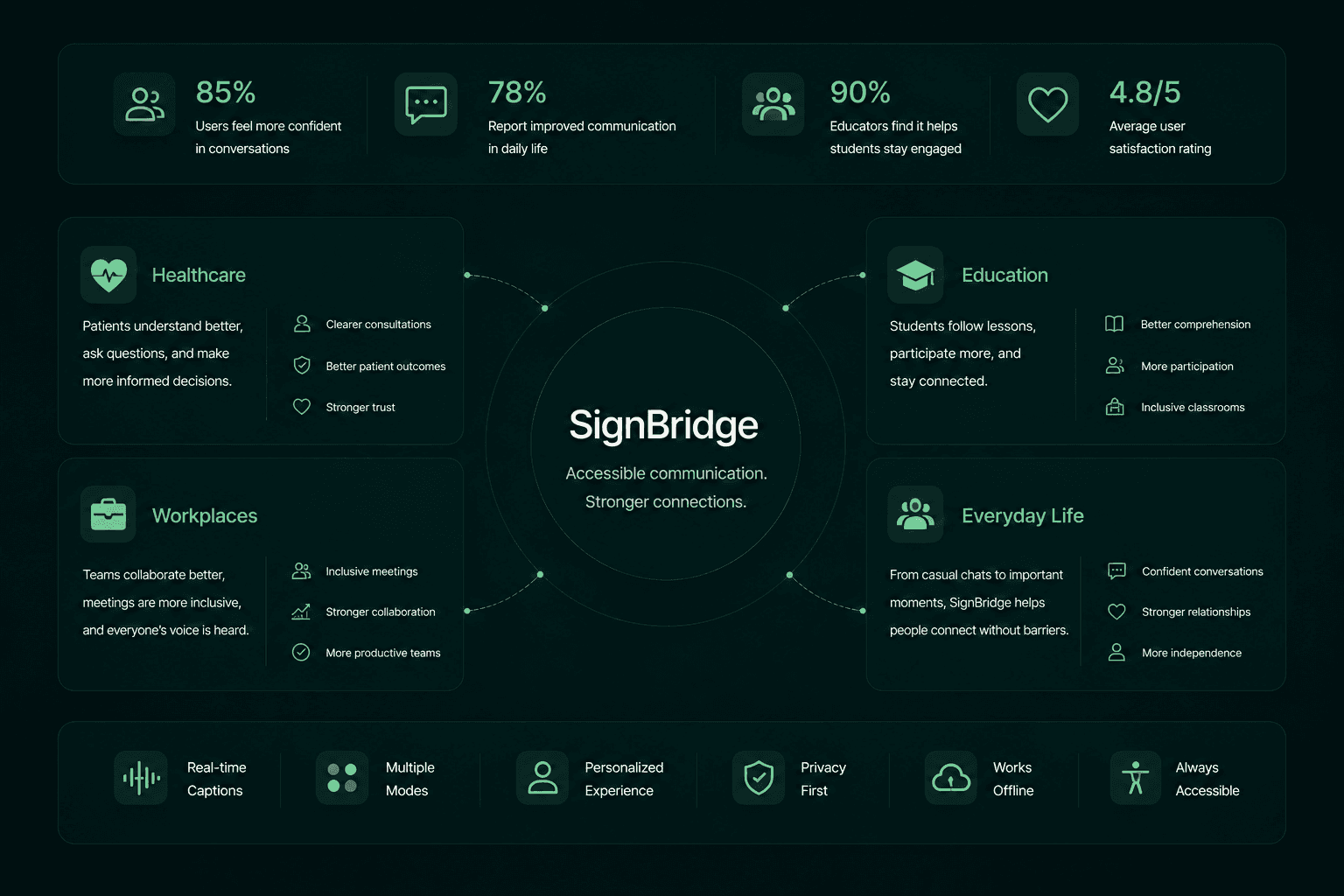
The final solution combines real-time captioning, transcript management, and accessibility tools into a unified communication experience designed around participation rather than transcription.
By helping users follow conversations more confidently, SignBridge supports more inclusive experiences across healthcare, education, workplaces, and everyday life.
Reflection
This project reinforced that accessibility is not a feature layer added to a product. It is a design mindset that shapes how people access, understand, and participate in experiences.

The final solution combines real-time captioning, speaker identification, transcript management, and accessibility customization into a unified communication experience.
Instead of focusing solely on speech recognition, SignBridge was designed to support the entire conversation journey from understanding information in real time to revisiting important discussions later.